Marketing 7.0: A Guide for Thinking Marketers in the Age of AI
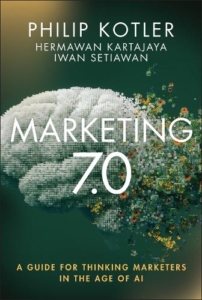 This post is about Marketing 7.0 by Philip Kotler, Hermawan Kartajaya and Iwan Setiawan. It’s not a summary, but more about concepts and reflection on parts that I found especially interesting.
As the Japanese translated version normally takes at least 6 months to be released, I went ahead and got the English version e-book on Rakuten kobo again.
Kotler is always worth reading, and Marketing 7.0 is no exception. Many of the concepts were a continuation of his previous Marketing X.0 theories, adapted to the age of AI. AI has quickly evolved over the past few years. Just a few years ago, AI was hailed primarily as a tool for idea and content generation. Today, its role has expanded far beyond that. Filtered, a learning technology company, analyzed discussions on forums like Reddit and Quora and found that the most common use of AI in 2025 was for therapy and companionship.
Anyway, the book’s key takeaway was that even in the age of AI, human behavior and emotional connection remain at the heart of digital marketing. If you want customers to be loyal to your brand long-term, your marketing cannot just be optimized, it must also be emotionally and socially meaningful. Otherwise, it’s too easy for competitors to steal your customers away with the latest trends or lower prices.
So how can marketers create emotional and social meaning? One example is social proof. We probably already do this in various ways, such as customer ratings and reviews, follower and engagement counts on social media, and long queues outside of retail stores. These signals make brands appear popular, creating a perception of desirability and social validation. Owning a certain brand can also be a way for someone to express their identity, projecting traits such as sustainability, affluence, style, or trendy.
Traditional marketing was more of an art than science, perhaps because today’s data and technologies were not available. Now, digital marketing has become more data and performance-driven. Stakeholders want to see leads, sales, and revenue numbers grow quickly, so marketers have to focus on short-term results and rely on fast methods such as paid ads and promotions. The downside to this is rising ad prices, customer fatigue, and weak brand loyalty.
As a digital marketing specialist who differentiates myself through technical skills, this book was a valuable reminder not to lose the personal touch and creativity in marketing. The most effective campaigns engage people’s emotions and sense of meaning, and that human connection is what ultimately shows up in the numbers. I truly believe “anti-marketing” has been emerging for some time now. It’s still marketing, just a different approach: more intimate, personal, one-to-one connection, and less about projecting scale.